

The short answer: The comment record on the OCC and FDIC Community Reinvestment Act (CRA) proposal splits hard on thresholds. Banks and community groups still line up in three places: the limit on grant funds for indirect costs, the Federal Reserve's absence from the rulemaking, and the test for outside-assessment-area consideration. Those three are where a compliance team can start planning now.
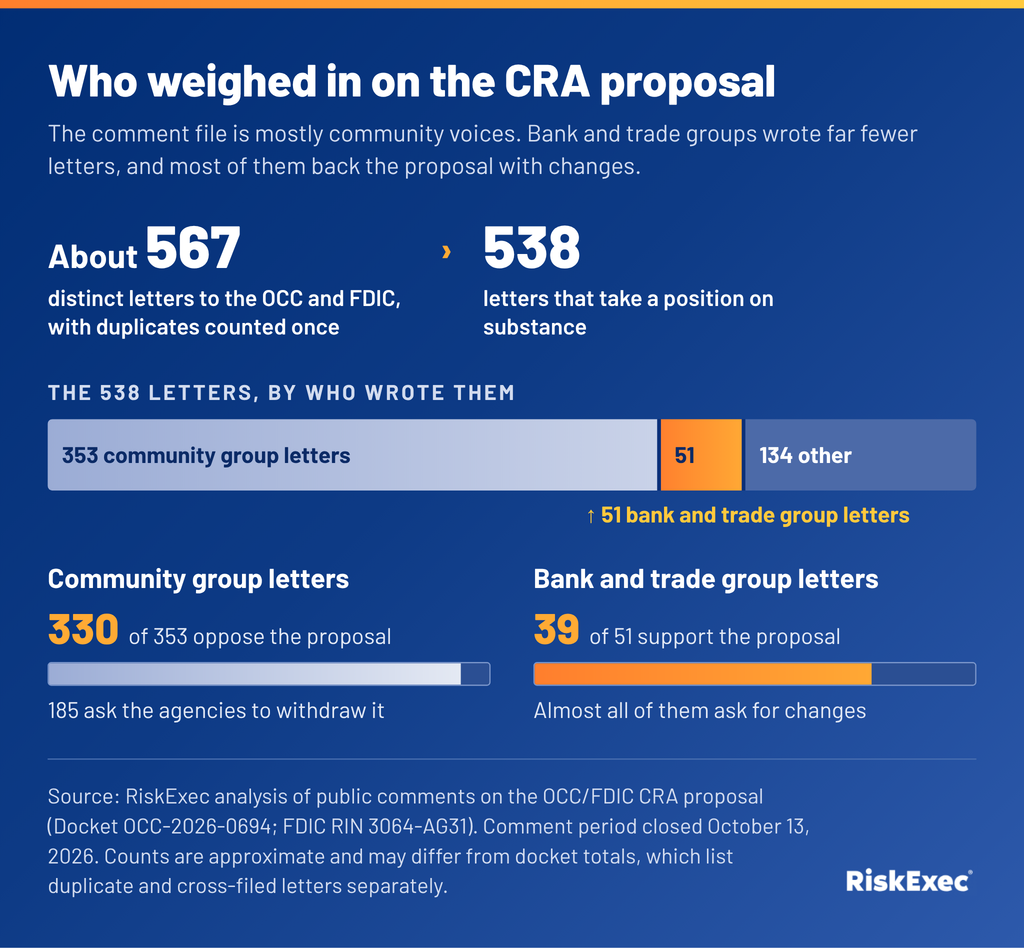
Of the 538 substantive letters on the proposal, 353 come from community groups, and 330 of those oppose the rule. Of the 51 bank and trade group letters, 39 support it. On paper, that's a standoff.
Read it provision by provision, though, and the picture changes.
The comment period on the OCC and FDIC proposed Community Reinvestment Act rule (91 FR 52114, published August 12, 2026) closed October 13, 2026. We classified the full record across both agencies: about 567 distinct letters, counting duplicate and cross-filed letters once. Of those, 538 take a position on the substance. One letter, from the Natural Resources Defense Council (NRDC), adds a petition with 6,873 signers.
Our counts won't match docket totals. The dockets list duplicate and cross-filed letters separately.
Community group letters account for 353 of the 538. Of those, 330 oppose the proposal and 185 want it withdrawn. Bank and trade group letters account for 51, and 39 of those support the proposal, almost all with changes.
This is still a proposal. No final rule has been issued, banks are examined under the current framework today, and the Federal Reserve did not join the rulemaking.
On thresholds, the camps split the way you'd expect. Further down the list, they start to converge.
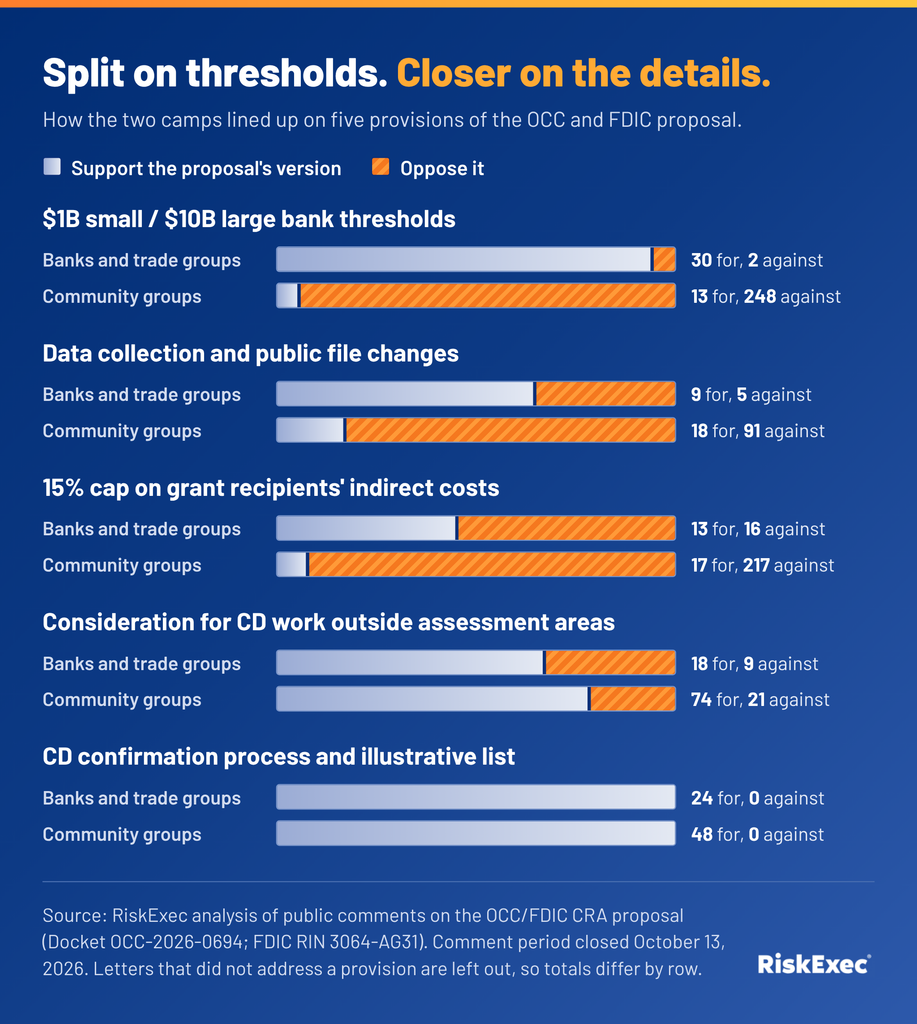
The bank side isn't uniform, either. The Mortgage Bankers Association (MBA) and the Community Development Bankers Association (CDBA) broke ranks on thresholds. CDBA and the National Bankers Association (NBA), which speak for CDFI and minority banks, sided with community groups on the large bank threshold and on the limit on grant funds for indirect costs. The NBA's letter puts it sharply: "Congress has enlarged the container; the Agencies propose to reduce the incentive to fill it."
Community groups mostly oppose the proposal. Banks and trade groups mostly support it.
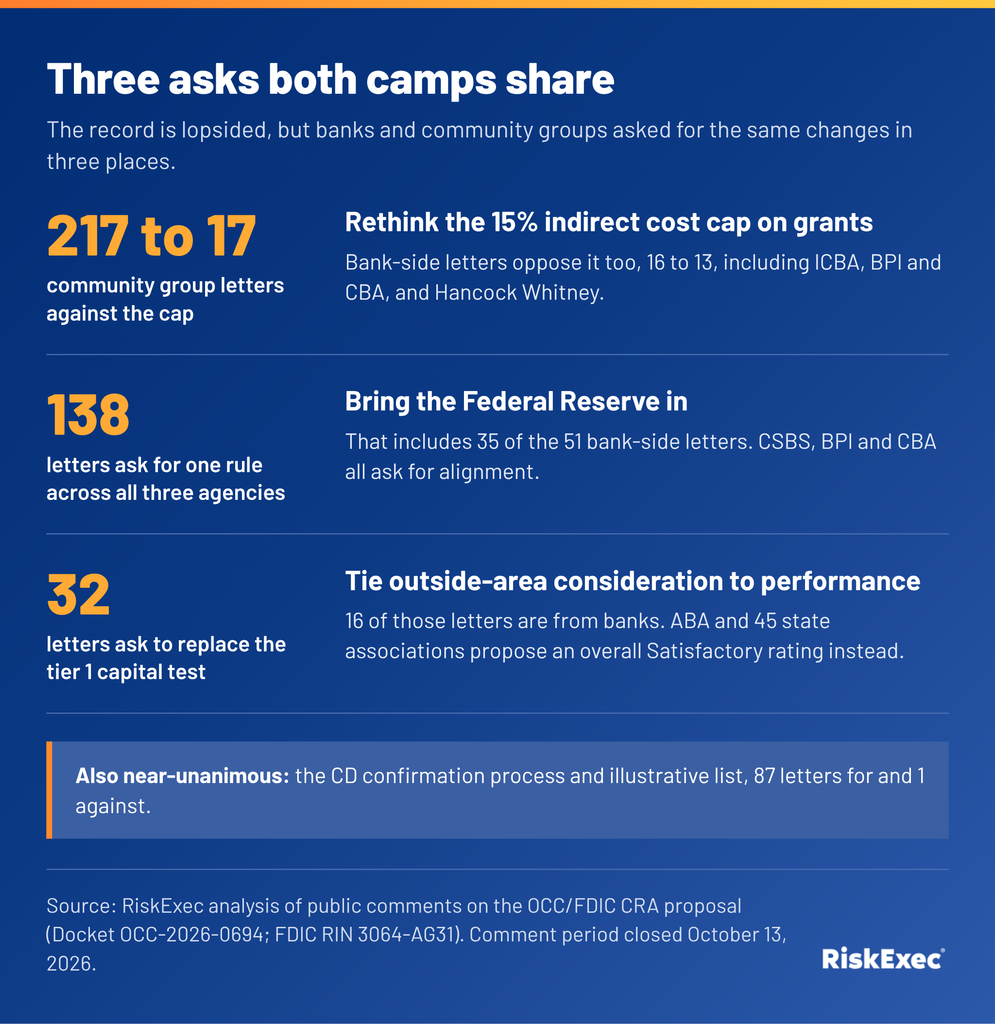
The proposal would credit only grants used directly for a program. For large banks, it would also cap the recipient's indirect costs at 15%.
Community group letters oppose that 217 to 17. More bank and trade group letters oppose it than support it, 16 to 13, including the Independent Community Bankers of America (ICBA), the Bank Policy Institute (BPI), and the Consumer Bankers Association (CBA). ICBA's objection is the sharpest. A cap built on the minimum overhead rate for small nonprofits, it writes, "would end up punishing the very organizations that rate was designed to promote."
Both commenter groups oppose the limit on grant funds for indirect costs.
This one drew the widest agreement. 138 letters ask for one rule across all three agencies, including 35 of the 51 bank and trade group letters.
The Conference of State Bank Supervisors (CSBS) wants a framework that applies evenly "regardless of a bank's charter type or federal supervisor." BPI and CBA went further. They'd accept a narrower rule to get the Fed on board, "even if those revisions require scaling back the scope of the changes made in this rulemaking."
For state member banks, that leaves an open question: which rulebook will their peers be on?
This is the messy one. Most commenters like the concept, 112 letters to 35. The argument is over the gate.
The proposal ties eligibility to 0.625% of tier 1 capital per assessment area. 32 letters ask to replace that test with a performance standard, 16 of them from banks and trade groups and 11 from community groups. The American Bankers Association (ABA), joined by 45 state associations, proposes an overall Satisfactory rating instead. The National Association of Affordable Housing Lenders (NAAHL) wants "a standard based on a bank's demonstrated CRA performance." A group of nine specialized banks says a fixed capital threshold "would not account for available local opportunities or actual responsiveness."
Most community group letters on this point push the other way, though. They call 0.625% too low.
The confirmation process and the illustrative list of qualifying activities: 87 letters for, 1 against.
The complaints are about speed. Fourteen letters want response deadlines, and 30 days is the usual ask. Separately, the OCC is taking comment through December 7, 2026 on its CRA Qualifying Activity Confirmation Request Form, which it expects about 22 institutions a year to use.
Data is where the split hits peer analysis. Community group letters oppose the proposal's data changes 91 to 18, and 68 letters ask to keep reporting for banks of $10 billion or less. One large bank's letter notes that only 2.4% of institutions would stay under the large bank reporting framework.
When RiskExec ran the proposed thresholds against 2024 data, the reporting population shrank about 60%. Reported loan volume fell only about 13%.
Proposed thresholds applied to 2024 data: about 60% fewer reporters, about 13% less reported loan volume.
The record doesn't tell anyone what the agencies will finalize. It does show where a deeply divided file agrees. Grant documentation and confirmation requests pay off under the current rule and the proposal alike, so they're safer places to spend this quarter than anything tied to a threshold outcome.
The threshold fight drew the volume. The shared asks are where planning starts.
RiskExec supports CRA data collection, geocoding, and peer analysis. Request a demo.
No. The OCC and FDIC published the proposed Community Reinvestment Act rule on August 12, 2026 (91 FR 52114), and the comment period closed October 13, 2026. No final rule has been issued, and banks are examined under the current CRA framework today.
As of October 27. 2026, RiskExec counted about 567 distinct letters across both agencies, counting duplicate and cross-filed letters once. Of those, 538 take a position on the substance. One letter, from the Natural Resources Defense Council, adds a petition with 6,873 signers. Docket totals run higher because they list duplicates separately.
Community groups mostly oppose it: 330 of 353 community group letters, with 185 asking the agencies to withdraw it. Banks and trade groups mostly support it: 39 of 51 letters, almost all with requested changes.
In three places: the limit on grant funds for indirect costs, the Federal Reserve's absence from the rulemaking, and the test for outside-assessment-area consideration. Commenters on both sides raised concerns about each one.
The proposal would credit only grants used directly for a program and, for large banks, cap a grant recipient's indirect costs at 15%. Community group letters oppose it 217 to 17, and bank and trade group letters oppose it 16 to 13.
The Federal Reserve did not join the OCC and FDIC rulemaking. Until it acts, state member banks may be examined under a different CRA framework than their OCC and FDIC peers. 138 letters, including 35 of 51 bank and trade group letters, ask for one rule across all three agencies.
The proposal ties eligibility for outside-assessment-area consideration to 0.625% of tier 1 capital per assessment area. Most commenters support the concept, 112 letters to 35. 32 letters ask to replace the capital test with a performance standard, while most community group letters on this point call 0.625% too low.
Community group letters oppose the proposal's data changes 91 to 18, and 68 letters ask to keep reporting for banks of $10 billion or less. When RiskExec ran the proposed thresholds against 2024 data, the reporting population shrank about 60% while reported loan volume fell only about 13%.
Yes. The OCC is taking comment through December 7, 2026 on its CRA Qualifying Activity Confirmation Request Form. The OCC expects about 22 institutions a year to use it.
Start with work that pays off under the current rule and the proposal alike: inventory community development grants and recipients' indirect-cost rates, calculate 0.625% of tier 1 capital for each assessment area, track both rulebooks if you're a state member bank, and use the confirmation process for novel activities.
The comment record shows where the CRA debate stands today. Our virtual event on December 9, 2026 looks at what compliance teams should be working on next. Save your seat.
This analysis first ran in The Examination Edge, RiskExec's newsletter for CRA, fair lending, and compliance professionals at financial institutions.